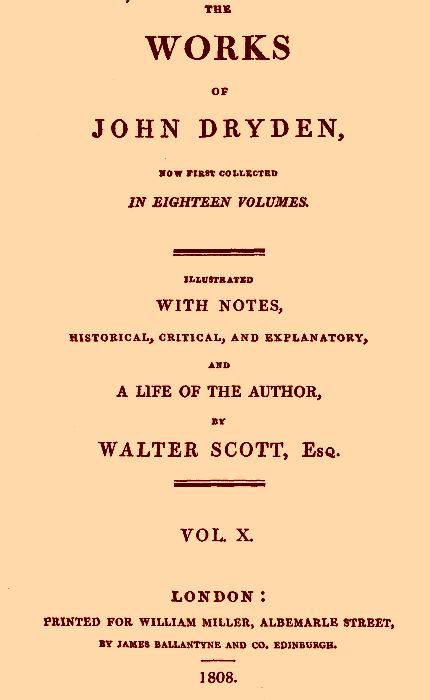
The Works of John Dryden, now first collected in eighteen volumes. Volume 10
Автор: Джон Драйден
Видавництво: Project Gutenberg
В наявності
Рік видання2016

★3.8/5
Формати
Мова
The Religio Laici, according to Johnson, is almost the only work of Dryden which can be considered as a voluntary effusion. I do not see much ground for this assertion. Dryden was indeed obliged to write by the necessity of his circumstances; but the choice of the mode in which he was to labour was his own, as well in his Fables and other poems, as in that which follows. Nay, upon examination, the Religio Laici appears, in a great measure, a controversial, and almost a political poem; and, being such, cannot be termed, with propriety, a voluntary effusion, any more than "The Medal," or "Absalom and Achitophel." It is evident, Dryden had his own times in consideration, and the effect which the poem was likely to produce upon them. Religious controversy had mingled deeply with the party politics of the reign of Charles II. Divided, as the nation was, into the three great sects of Churchmen, Papists, and Dissenters, their several creeds were examined by their antagonists with scrupulous malignity, and every hint extracted from them which could be turned to the disadvantage of those who professed them. To the Catholics, the dissenters objected their cruel intolerance and jesuitical practices; to the church of England, their servile dependence on the crown, and slavish doctrine of non-resistance. The Catholics, on the other hand, charged the reformed church of England with desertion from the original doctrines of Christianity, with denying the infallibility of general councils, and destroying the unity of the church; and against the fanatics, they objected their anti-monarchical tenets, the wild visions of their independent preachers, and their seditious cabals against the church and state. While the church of England was thus assailed by two foes, who did not at the same time spare each other, it probably occurred to Dryden, that he, who could explain her tenets by a plain and philosophical commentary, had a chance, not only of contributing to fix and regulate the faith of her professors, but of reconciling to her, as the middle course, the Catholics and the fanatics. The Duke of York and the Papists, on the one hand, were urging the king to the most desperate measures; on the other, the popular faction were just not in arms. The king, with the assistance and advice of Halifax, was trimming his course betwixt these outrageous and furious torrents. Whatever, therefore, at this important crisis, might act as a sedative on the inflamed spirits of all parties, and encourage them to abide with patience the events of futurity, was a main point in favour of the crown. A rational and philosophical view of the tenets of the national church, liberally expressed, and decorated with the ornaments of poetry, seemed calculated to produce this effect; and as I have no doubt, as well from the preface, as from passages in the poem, that Dryden had such a purpose in view, I have ventured to place the Religio Laici among his historical and political poems.
 Librarius
Коментарі
Немає коментарів. Будьте першим, хто залишить коментар!